
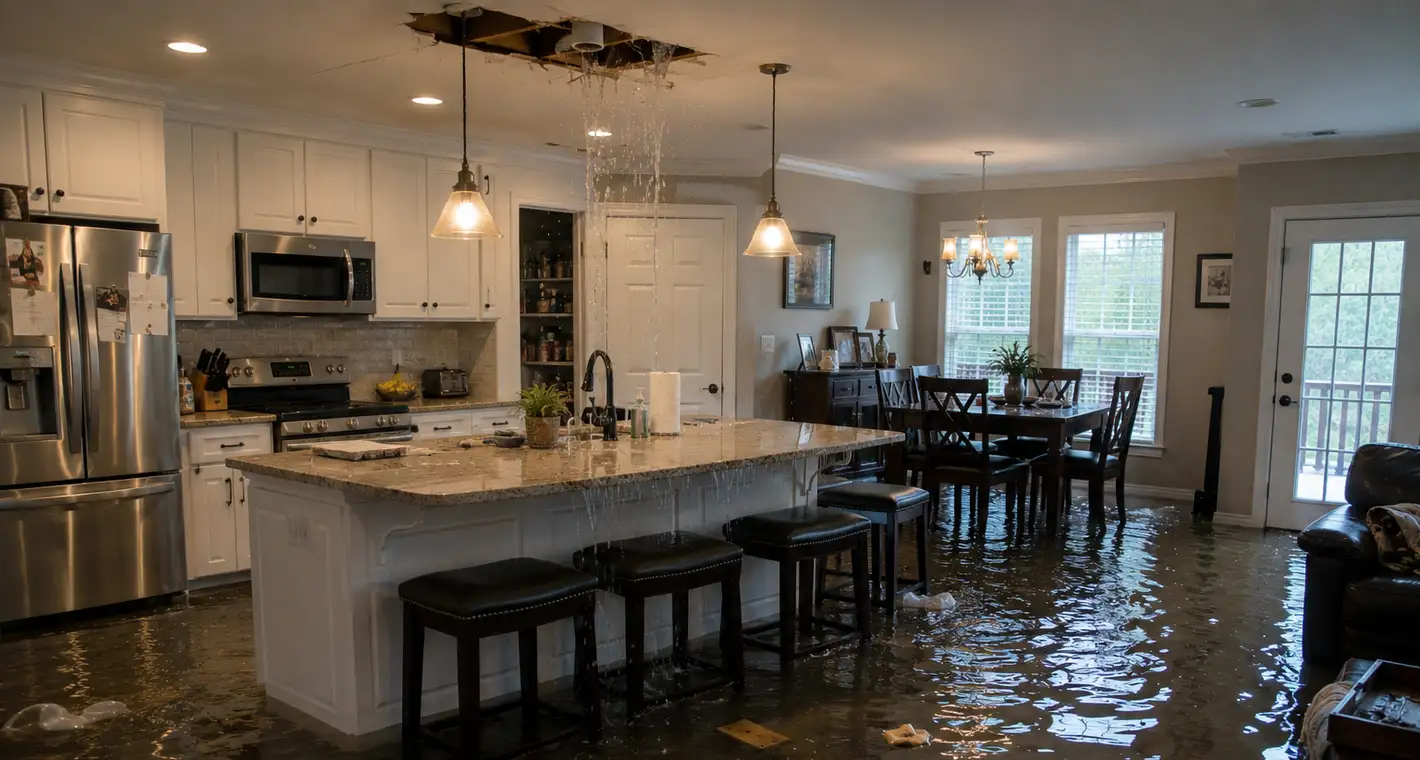
Water damage in Acton
Acton sits in Soledad Canyon in the Sierra Pelona at about 2,700 feet, between the Antelope Valley and the Santa Clarita Valley, with hills on both sides and drainages running through the community. Rural parcels of an acre and up, built mainly between the 1970s and the 2000s and more often custom than tract. Slab is usual, with raised floors on some older and steeper sites. Wells, septic and propane are common.
Before help arrives
- Shut the water off at the fixture or the main if you can reach it safely.
- Keep out of any room where water has reached outlets, cords, or the electrical panel.
- Lift furniture off wet carpet and move what you can to a dry floor.
- Photograph the damage and the failure point before anything is moved.
- Do not use a household vacuum to pick up standing water.
Common causes in Acton
Canyon drainage concentrating runoff
Water in a canyon does not spread out, it collects. Every slope above a property feeds the same few channels, and the crossings where a driveway meets one are the pinch points. Acton recorded about five and a half inches in a day during the August 2023 storm, and it was the low-water crossings and driveway culverts that failed rather than the roofs.
Hillside seepage into a cut pad
Building on a slope means cutting into the hill, and the cut face behind the house intercepts water moving through the soil after a wet week. That water arrives at the back of the pad below the surface, days after the rain stopped. It shows as a damp band along the rear wall of a garage or a lower room, and because it is tied to no plumbing at all it is regularly mistaken for a leak.
Well systems on individual parcels
Most of Acton is on private wells, with the pump, tank and controls in a shed or a garage corner. Nothing bills you for what escapes, so a failed fitting runs until somebody notices it. On sloped parcels the escaping water follows the grade rather than pooling where it started, and it can reach a lower part of the house or an outbuilding well away from the equipment that failed.
Hard freeze at canyon elevations
Cold air drains downhill and settles in the canyon bottoms overnight, so the low parts of Acton run colder than valley floor readings suggest. Exposed plumbing on the north side of a building, in a crawl space under an older raised floor, or in an unheated shop can freeze while the same run in Lancaster does not.
Drying a Acton home
Acton properties are individual enough that nothing is assumed. Some houses sit on slab, some on a raised floor over a crawl space, and additions built at different times can sit on different systems in the same building. Where a raised floor is involved, the space beneath holds water out of sight and the subfloor absorbs from below, so the crawl space is checked before the room above it.
The sequence itself does not change from house to house: extraction first, then air movers and dehumidifiers working together, with moisture readings logged each day until the affected materials match the dry baseline for that building. It is described in full on the water extraction and drying page.
Services available in Acton
- Water Extraction & DryingStanding water removal and controlled structural drying under moisture readings.
- Slab Leak DamageWater surfacing through a slab-on-grade foundation, located and dried out.
- Sewage CleanupContaminated water handled with containment, removal and cleaning.
- Mold RemediationGrowth that established after water sat longer than it should have.
- Burst pipe and supply line cleanup
- Water heater and appliance leak cleanup
- Ceiling and drywall water damage
- Moisture inspection and mapping
Areas covered in Acton
Providers cover Acton and the surrounding area, including Soledad Canyon Road, Crown Valley, Aliso Canyon, Escondido Canyon, Sierra Highway corridor and Angeles Forest Highway.
ZIP codes: 93510.
Frequently Asked Questions
- Will my homeowners insurance cover water damage?
- It depends on the cause rather than the damage. Policies commonly cover sudden and accidental events such as a burst supply line or a failed water heater. Damage that developed gradually from a long-standing leak, and damage from surface flooding, are usually handled differently or excluded. Photograph everything before it is moved, keep any failed part, and report the loss promptly.
- Should I turn off the electricity?
- If water has reached outlets, cords, appliances or the panel itself, treat the area as unsafe. Shut off the breaker only if you can reach the panel without standing in water and without touching anything wet. If you cannot, leave the area and have the utility or an electrician handle it.
- Should the culvert under our driveway be checked before winter?
- It is one of the few things out here worth walking every autumn. Culverts collect sediment, branches and whatever the last storm carried, and a partly blocked one behaves like no culvert at all once flow rises. When it overtops, the water crosses the driveway and heads for the pad.
- Our house has a crawl space rather than a slab. Does that change the drying?
- It changes where the work happens. Water from a failure above ends up under the floor instead of spreading across a slab, and the joists, subfloor and insulation then absorb it from underneath while the room looks dry. Wet insulation there is normally removed rather than dried. Air movement has to be established in the crawl space itself, and readings are taken on the framing rather than only on the finish floor.
- Is Acton served by the same providers as the valley floor?
- Yes, though the approach matters more than it does in town. Providers work the corridor between the Antelope Valley and Santa Clarita and Acton sits on it. Give the canyon and the cross street when you call rather than only a house number, and mention whether the last stretch is paved. Equipment trucks are heavy, and a soft canyon approach after a storm decides the arrival more than mileage does.
- Rain stopped days ago and the back wall of the garage is still getting damp. Why now?
- That is the signature of subsurface water reaching a cut pad rather than a plumbing failure. Rain soaks into the slope above, travels through the soil, and arrives at the cut face behind the structure on its own schedule, which can be several days later. It comes in low, along the rear wall, and it keeps arriving for as long as the slope is draining.