
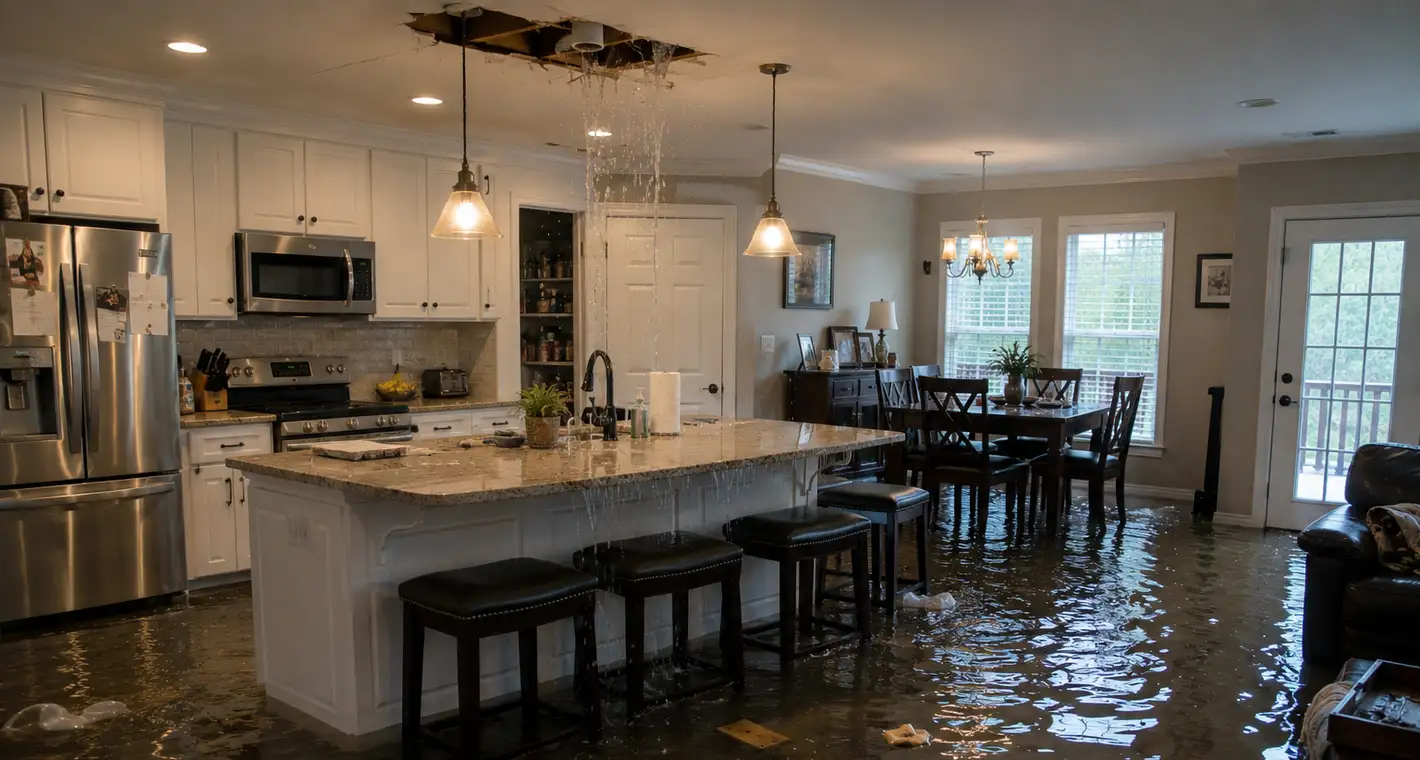
Water damage in Palmdale
Palmdale occupies the south end of the valley where the floor rises into the San Gabriel foothills, at around 2,650 feet. Little Rock Creek and the California Aqueduct both cross the city. Growth arrived in two waves, the late 1980s and the 2000s, with hillside tracts at Anaverde and Rancho Vista built on cut-and-fill pads. Slab-on-grade is standard, and many air handlers sit in the attic.
Before help arrives
- Shut the water off at the fixture or the main if you can reach it safely.
- Keep out of any room where water has reached outlets, cords, or the electrical panel.
- Lift furniture off wet carpet and move what you can to a dry floor.
- Photograph the damage and the failure point before anything is moved.
- Do not use a household vacuum to pick up standing water.
Common causes in Palmdale
Runoff arriving from above the pad
Anything built against the foothills takes water from uphill before it takes any of its own. Hillside tracts are terraced, and each pad relies on a graded swale and a ditch behind it to carry runoff around the house. Those fill with sediment over a few seasons, and once a swale is full the water crosses the pad instead. Palmdale took just over five inches in a day in August 2023, well beyond what that system is built to move.
Soil that moves under the slab
South valley ground mixes caliche hardpan with clays that swell as they take on water and shrink back through the dry months. A slab bearing on hardpan at one corner and soft fill at another rides that cycle unevenly. Copper cast into the concrete or buried in the fill beneath it moves with the slab, thins where it bends, and eventually weeps.
Attic air handlers and their condensate lines
Without a basement the air handler generally goes in the attic, directly above bedrooms and hallways. It produces condensate whenever it runs, and that water leaves through a narrow drain line that collects dust and growth until it blocks. The secondary pan under the unit is a backstop rather than a fix, and once it goes over the edge the first sign is a stain on a bedroom ceiling.
Cut-and-fill pads and later settlement
Levelling a sloped tract means cutting into the hill on one side of a street and filling on the other. Fill compacts over time even where it was placed correctly, and that settlement is never even across a lot. Drainage that worked when a house was new can fall toward a wall a decade later, and utility trenches running through fill become the path water follows toward the foundation.
Drying a Palmdale home
Two things stretch a Palmdale drying job. Hillside houses take water in at the pad and it enters at the wall base, so the wet band runs low and long rather than outward from one point. And where a loss began at an attic unit, the ceiling, the insulation above it and the wall below all hold water, so the ceiling is the end of the map rather than the start of it.
The sequence itself does not change from house to house: extraction first, then air movers and dehumidifiers working together, with moisture readings logged each day until the affected materials match the dry baseline for that building. It is described in full on the water extraction and drying page.
Services available in Palmdale
- Water Extraction & DryingStanding water removal and controlled structural drying under moisture readings.
- Slab Leak DamageWater surfacing through a slab-on-grade foundation, located and dried out.
- Sewage CleanupContaminated water handled with containment, removal and cleaning.
- Mold RemediationGrowth that established after water sat longer than it should have.
- Burst pipe and supply line cleanup
- Water heater and appliance leak cleanup
- Ceiling and drywall water damage
- Moisture inspection and mapping
Areas covered in Palmdale
Providers cover Palmdale and the surrounding area, including Rancho Vista, Anaverde, Palmdale Hills, Lake Palmdale, Desert View Highlands, Sierra Highway corridor and City Ranch.
ZIP codes: 93550, 93551, 93552.
Frequently Asked Questions
- Will my homeowners insurance cover water damage?
- It depends on the cause rather than the damage. Policies commonly cover sudden and accidental events such as a burst supply line or a failed water heater. Damage that developed gradually from a long-standing leak, and damage from surface flooding, are usually handled differently or excluded. Photograph everything before it is moved, keep any failed part, and report the loss promptly.
- Should I turn off the electricity?
- If water has reached outlets, cords, appliances or the panel itself, treat the area as unsafe. Shut off the breaker only if you can reach the panel without standing in water and without touching anything wet. If you cannot, leave the area and have the utility or an electrician handle it.
- There is a stain on a bedroom ceiling and no plumbing above it. Where is it from?
- In this housing stock the usual answer is the air handler in the attic. Its condensate line runs whenever the system does, and when that line blocks, the pan under the unit fills and then overflows. The stain appears below the pan rather than below the unit itself.
- How does a slab leak differ from water arriving from outside?
- The pattern differs. A slab leak surfaces in the same place regardless of weather, often feels warm if a hot line is involved, and keeps the water meter turning with everything in the house closed. Water arriving from the pad follows the storm, enters along an exterior wall at floor level, and usually reaches more than one room on that side of the house.
- Do the aqueduct and Lake Palmdale flood the neighbourhoods around them?
- Those are managed water bodies rather than natural channels, and they are not the usual source of a residential loss here. What reaches houses is runoff coming off the foothills and down the natural washes during a winter storm or a summer cell, moving as sheet flow across streets and pads.
- Our house is on a hillside pad. What should be checked before winter?
- The drainage behind and beside the pad, which is what stands between the house and everything coming off the slope. Look at the swale or ditch above the rear wall for sediment, plant growth or a fence line that has blocked it, and check that the side yard area drains are open rather than silted in. On a terraced lot your house does not have to be the one that failed.