
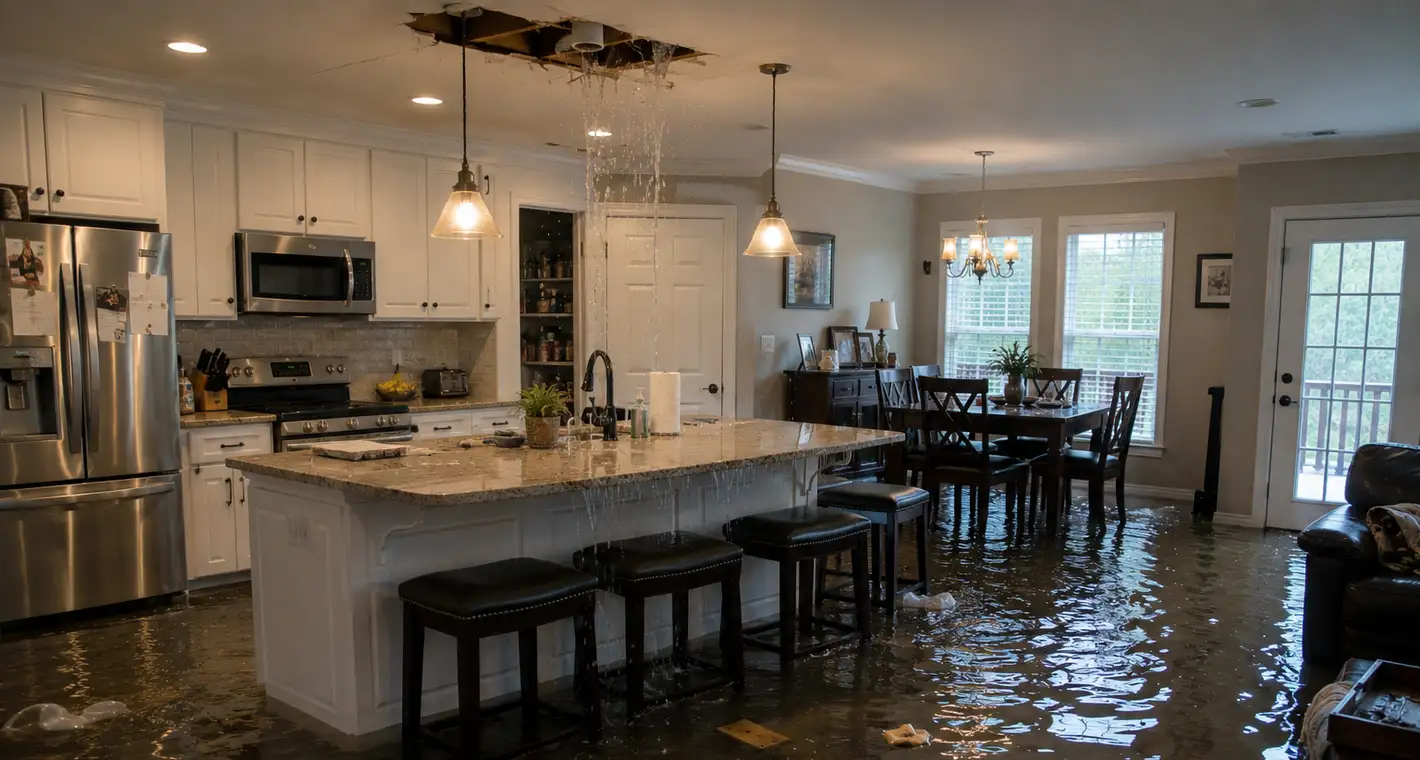
Water damage in Lake Los Angeles
Lake Los Angeles lies about fifteen miles east of Palmdale on the open east valley floor, laid out around a lakebed from a 1960s land promotion that has been dry for most of its history. Houses date mainly from the 1970s and from the 2000s, on large flat lots reached by long driveways. Slab-on-grade throughout, with wells and septic systems on nearly every parcel and very little municipal sewer.
Before help arrives
- Shut the water off at the fixture or the main if you can reach it safely.
- Keep out of any room where water has reached outlets, cords, or the electrical panel.
- Lift furniture off wet carpet and move what you can to a dry floor.
- Photograph the damage and the failure point before anything is moved.
- Do not use a household vacuum to pick up standing water.
Common causes in Lake Los Angeles
Septic systems and saturated leach fields
Nearly every property here handles its own waste, and a leach field works only while the ground around it can still accept water. A wet winter, a laundry pattern that concentrates use, or roots finding the lines will fill the field faster than it drains. When it backs up, it returns through the drain closest to the floor, which is normally a hall bathroom tub or shower.
Well equipment running unwatched
The pump, pressure tank and controller usually sit in a small pump house or a corner of the garage, and nothing meters what they deliver. A failed tank bladder makes the pump cycle constantly; a split fitting simply pours. Because the equipment is often some distance from the living space and nobody has reason to look at it daily, these are found by the sound of a pump that will not stop rather than by seeing water.
Long shallow service runs and winter cold
Water travels a long way from the wellhead or the meter to the house on lots this size, and older runs were laid shallow. Open ground at this elevation on a clear January night takes a hard freeze with nothing to hold heat in, and a shallow line under an unpaved driveway has very little cover over it.
Sheet flow off the eastern washes
The washes coming out of the San Gabriels lose their banks once they reach the open valley and spread into a shallow front several hundred feet wide. That front crosses roads and lots without ever looking like a river. On flat parcels it arrives at the house as a slow rise rather than a rush, which gives more time to react and also more time for the ground at the foundation to take on water.
Drying a Lake Los Angeles home
Distance shapes the work here more than the buildings do. Equipment has to be brought out and left running on a property that may sit some way from anything else, and drying continues across several days of daily readings. Where the loss was septic in origin, cleaning comes before drying, because drying first would set contamination into the material being dried.
The sequence itself does not change from house to house: extraction first, then air movers and dehumidifiers working together, with moisture readings logged each day until the affected materials match the dry baseline for that building. It is described in full on the water extraction and drying page.
Services available in Lake Los Angeles
- Water Extraction & DryingStanding water removal and controlled structural drying under moisture readings.
- Slab Leak DamageWater surfacing through a slab-on-grade foundation, located and dried out.
- Sewage CleanupContaminated water handled with containment, removal and cleaning.
- Mold RemediationGrowth that established after water sat longer than it should have.
- Burst pipe and supply line cleanup
- Water heater and appliance leak cleanup
- Ceiling and drywall water damage
- Moisture inspection and mapping
Areas covered in Lake Los Angeles
Providers cover Lake Los Angeles and the surrounding area, including Lake Los Angeles townsite, Sun Village, Wilsona Gardens, 170th Street East, Palmdale Boulevard corridor and Avenue N corridor.
ZIP codes: 93591.
Frequently Asked Questions
- Will my homeowners insurance cover water damage?
- It depends on the cause rather than the damage. Policies commonly cover sudden and accidental events such as a burst supply line or a failed water heater. Damage that developed gradually from a long-standing leak, and damage from surface flooding, are usually handled differently or excluded. Photograph everything before it is moved, keep any failed part, and report the loss promptly.
- Should I turn off the electricity?
- If water has reached outlets, cords, appliances or the panel itself, treat the area as unsafe. Shut off the breaker only if you can reach the panel without standing in water and without touching anything wet. If you cannot, leave the area and have the utility or an electrician handle it.
- Is well water responsible for water heaters failing early?
- Mineral content is a real factor. Groundwater in this basin is hard, and the scale it deposits collects in the bottom of a tank where it insulates the burner or element from the water and drives the metal hotter than it should run.
- How long does a provider take to reach a property out here?
- Longer than in Lancaster or Palmdale, and the variable is usually the last mile rather than the distance. Unpaved approaches soften after a storm and a truck carrying drying equipment is heavy. It helps to give cross streets and a landmark rather than only the address when you call, and to say whether the final approach is graded or dirt.
- Nothing is visibly wet but the pump keeps running. What does that mean?
- It means the system is losing water somewhere you cannot see it: a split in the buried run between the well and the house, a leak under the slab, or a failed fixture valve. Shut the pump breaker off and watch whether pressure holds. If it drops with everything in the house closed, the loss is on the pressurised side, and on sandy soil the ground above a buried break can look dry for a long time.
- Our septic backed up into the bathtub. Can that simply be cleaned and dried?
- Not on porous material. The problem with a septic backup is contamination rather than moisture, and what soaked into carpet, padding, the bottom band of drywall or a particleboard vanity stays there after the water is gone. Those come out. Hard surfaces such as tile, sealed concrete and framing are cleaned and kept.