
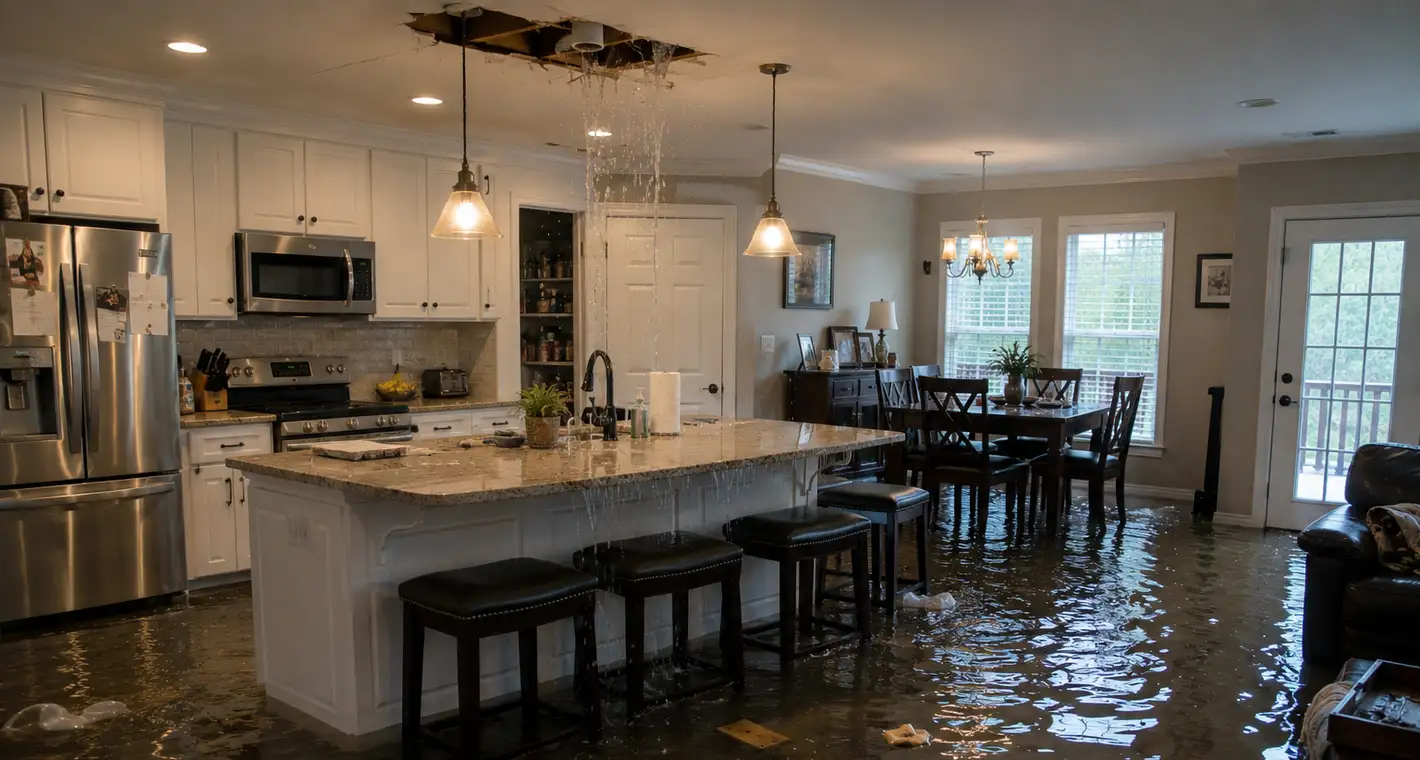
Water damage in Pearblossom
Pearblossom lies along State Route 138 at the foot of the San Gabriels, on the alluvial fan that Big Rock Creek has built out into the valley, at roughly 3,000 feet. Scattered rural properties on acreage rather than streets of tract houses, built from the 1950s onward. Slab-on-grade predominates, and most parcels run their own well and septic system.
Before help arrives
- Shut the water off at the fixture or the main if you can reach it safely.
- Keep out of any room where water has reached outlets, cords, or the electrical panel.
- Lift furniture off wet carpet and move what you can to a dry floor.
- Photograph the damage and the failure point before anything is moved.
- Do not use a household vacuum to pick up standing water.
Common causes in Pearblossom
Living on an active alluvial fan
The ground this community sits on was built by the creek dropping its load as it left the canyon, and that process has not stopped. On a fan the channel is not fixed: a large storm can abandon one path and cut another across ground that has been dry for decades. A house is not necessarily protected by sitting away from the current channel, and the flow arrives loaded with sand and rock.
Post-fire runoff from the slopes above
The Bobcat Fire came down the north side of the range into Juniper Hills and Valyermo in September 2020, immediately above this stretch of the 138. Burned ground stays water-repellent for years, and the runoff it produces reaches the fan as debris-laden flow. For properties at the head of the fan, the winters following a fire on the slope above are materially different from the ones before it.
Wells, storage tanks and long service runs
Parcels this size commonly run a well into a storage tank and then a booster pump to the house, which means three sets of fittings and a long buried line instead of one meter at the street. A float valve that sticks overfills the tank; a split in the buried run empties it.
Freezing nights at the base of the range
At three thousand feet against the mountain front, winter nights here run colder and longer than on the valley floor. Exposed plumbing at a tank, a pump house or an outbuilding, and hose bibs left connected, are the usual casualties. Where a property is used seasonally or the owners are away in January, a line that splits at four in the morning runs unattended until somebody arrives.
Drying a Pearblossom home
Sand is the thing that changes drying here. Water arriving off the fan carries a load of fine sediment that settles into carpet, under flooring and into wall cavities, and it stays behind after the water is gone. That material is removed rather than dried, and the assembly behind it is checked with a meter, because sediment holds moisture against framing long after a surface reads dry.
The sequence itself does not change from house to house: extraction first, then air movers and dehumidifiers working together, with moisture readings logged each day until the affected materials match the dry baseline for that building. It is described in full on the water extraction and drying page.
Services available in Pearblossom
- Water Extraction & DryingStanding water removal and controlled structural drying under moisture readings.
- Slab Leak DamageWater surfacing through a slab-on-grade foundation, located and dried out.
- Sewage CleanupContaminated water handled with containment, removal and cleaning.
- Mold RemediationGrowth that established after water sat longer than it should have.
- Burst pipe and supply line cleanup
- Water heater and appliance leak cleanup
- Ceiling and drywall water damage
- Moisture inspection and mapping
Areas covered in Pearblossom
Providers cover Pearblossom and the surrounding area, including Pearblossom Highway, Big Rock Creek wash, Longview Road, Fort Tejon Road, Valyermo and Llano.
ZIP codes: 93553.
Frequently Asked Questions
- Will my homeowners insurance cover water damage?
- It depends on the cause rather than the damage. Policies commonly cover sudden and accidental events such as a burst supply line or a failed water heater. Damage that developed gradually from a long-standing leak, and damage from surface flooding, are usually handled differently or excluded. Photograph everything before it is moved, keep any failed part, and report the loss promptly.
- Should I turn off the electricity?
- If water has reached outlets, cords, appliances or the panel itself, treat the area as unsafe. Shut off the breaker only if you can reach the panel without standing in water and without touching anything wet. If you cannot, leave the area and have the utility or an electrician handle it.
- Our well feeds a storage tank. What fails on that setup?
- The float or fill valve at the tank, which overfills and then overflows, and the buried line between tank and house, which empties the tank into the ground. Both run without anything inside the house indicating a problem. A useful habit is knowing roughly how often your pump should cycle on a normal day, so a pump running far more than that reads as a symptom rather than background noise.
- How long does burned ground above us stay a problem?
- Several seasons rather than one. The water-repellent layer left in the soil breaks down gradually and vegetation takes years to hold the slope again, so runoff stays elevated across that period and drops back slowly. The practical consequence is that drainage around your own property, culverts, ditches and the fall of the ground near walls, deserves checking every autumn during those years rather than once.
- Is anyone dispatched this far out of Palmdale?
- Yes. The 138 corridor is covered on the same runs as the east valley, and distance from Palmdale is not the obstacle. What lengthens an arrival is a wet unpaved approach, or an address that is hard to find in the dark on acreage. A cross street, a mile marker or a described landmark given at the time of the call does more than the street number alone.
- We are not near the creek channel. Does that put us out of its way?
- Not reliably, because on an alluvial fan the channel moves. The fan is the deposit of everything the creek has carried out of the canyon over a long period, and it was built by the flow taking a different route each time. What matters more than distance to the current channel is where your property sits on the fan, how the ground falls across it, and whether anything upstream has been graded or blocked.